
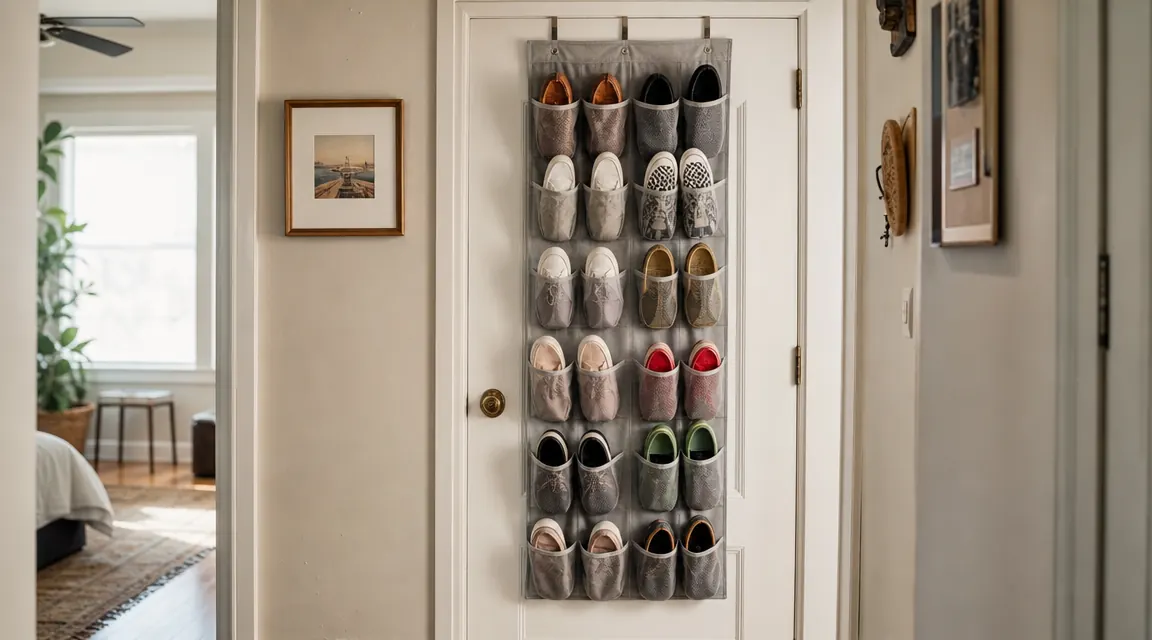
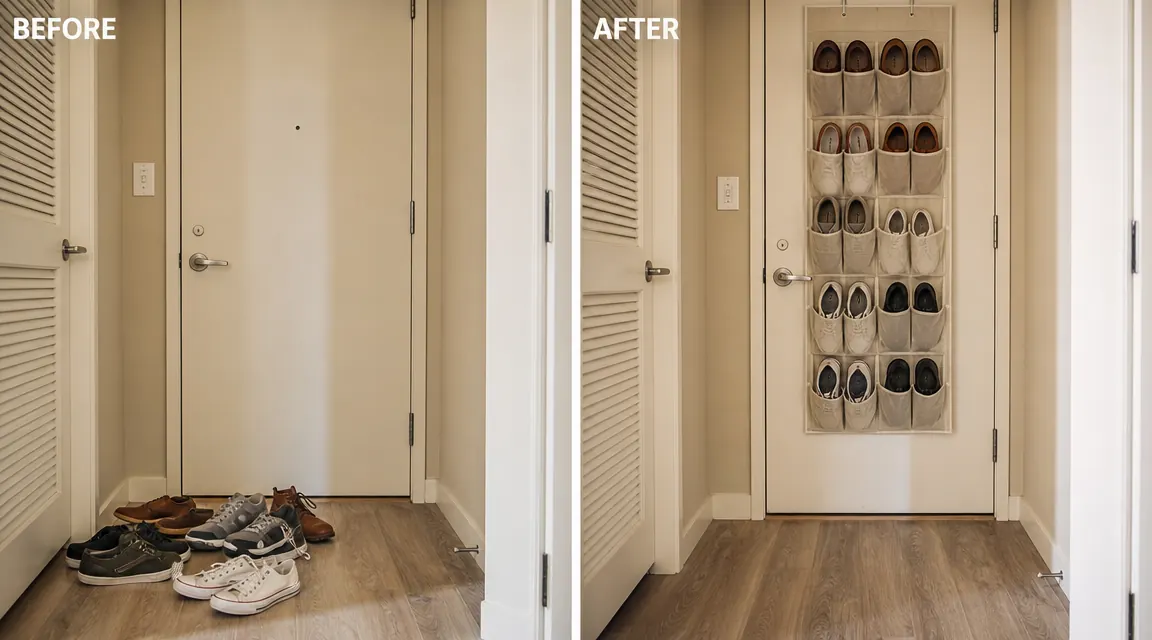
My third apartment had a 28-inch-wide entryway hallway. Not a real entryway. More of a legal obligation between the front door and the living room. I had four pairs of shoes I wore regularly, plus three pairs I kept for weekends, plus a pair of rain boots I could not figure out where to put. That is ten shoes on a floor the size of a bathmat. I bought the Amazon Basics 24-pocket over-door shoe organizer on a Tuesday afternoon and had it hung by Wednesday morning. That was two years and two moves ago. It has lived on three different doors in three different apartments, and I still use it every single day.
This is the review I wish existed before I bought it. Not the summary version, not the one that calls it 'great value' and stops there. The one that tells you the pocket depth in inches, what happens to the mesh after 24 months of use, whether it fits on a hollow-core door without scratching anything, and which situations make this organizer the wrong choice. I will cover all of it.
The Quick Verdict
The best entryway fix under $15 for renters with small flats and sandals, but pocket depth limits it to shoes under a size 11 men's and the hooks can rock on hollow-core doors thinner than 1.375 inches.
Amazon Check Today's Price →Still using a floor pile? Here is the $10 fix that clears it in ten minutes.
The Amazon Basics 24-pocket shoe organizer fits most interior apartment doors with no tools, no drilling, and no deposit risk. At current pricing it costs less than a single pint of paint.
Amazon Check Today's Price on Amazon →How I Have Used It Over Two Years
First apartment: studio in a 1970s building with hollow-core interior doors exactly 1.375 inches thick at the top. The organizer hung on the back of the front door, which opened into the hallway. I loaded 18 of the 24 pockets with shoes, leaving the bottom six empty because I did not have enough pairs to fill them. The hooks sat fine. No wobble, no scratching on the door surface.
Second apartment: a one-bedroom in a newer building where the front door was a solid-core exterior door, thicker at about 1.75 inches. The hooks did not reach the back side of the door cleanly. I moved the organizer to the back of the bedroom closet door instead, which was a hollow-core interior door again at 1.375 inches. That worked perfectly. So in this apartment it lived inside the closet, which turned out to be even more useful than the entryway location because I could pull on shoes without bending down.
Third apartment, current: the front door is hollow-core interior style even though it is the unit entry door, which seems unusual but is common in garden-style complexes built in the 1990s. The organizer is back on the front door. I have had it in this location for seven months and it looks exactly like it did when I hung it.
The Mesh: What 24 Months of Pulling and Stuffing Looks Like
The pockets are a medium-weight grey polyester mesh. Not the flimsy netting you find on cheap organizers that runs $4 shipped from overseas. Not reinforced canvas either. It sits in the middle. After two years of pulling shoes in and out every morning, I have zero torn pockets, zero blown seams, and no visible fraying at the pocket tops. The mesh has loosened slightly on four of the pockets I use most, meaning the shoes sit a little lower than they did originally, but the structural integrity is intact.
The stitching at the top of each pocket, where the mesh attaches to the backing strip, is the area most likely to wear first. I can see slight thread fading on two of the high-use pockets, but nothing has separated. My honest assessment: this mesh will survive three to four more years of apartment use before you notice real degradation. If you are buying it for a mudroom in a house with four kids and daily winter boot use, that timeline shortens considerably.
After 24 months of pulling shoes in and out every morning, I have zero torn pockets, zero blown seams, and no fraying at the pocket tops. The mesh is looser on four high-use pockets, but structurally nothing has moved.
Pocket Depth and What Actually Fits
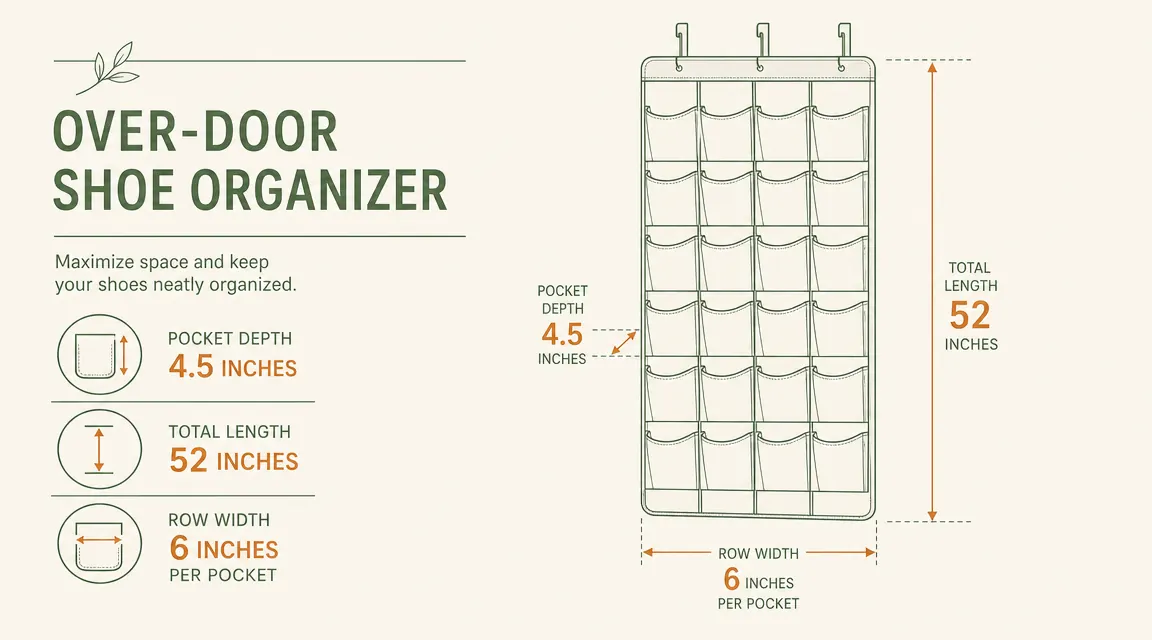
Each pocket measures roughly 4.5 inches deep, 6 inches wide, and 5.5 inches tall. Those numbers matter. A women's size 8 sneaker in a Nike Pegasus style fits with the heel poking out about half an inch past the pocket top. A women's size 10 sneaker in the same style fits only if you angle it diagonally, and the heel sticks out almost 2 inches. A men's size 11 sneaker does not fit at all, not even angled. The toe hits the back of the pocket and the heel hangs completely unsupported.
Where this organizer genuinely earns its stars: women's flats (sizes 6 through 9 sit fully inside the pocket), women's sandals, flip-flops, ballet flats, small sneakers up to about a women's 9, kids' shoes in any size under about 12 youth, and household items I started storing once I ran out of shoes. I keep a folded reusable grocery bag, a pair of gardening gloves, and a tube of shoe polish in three of the lower pockets. Works perfectly for all of those.
The 24-pocket count sounds like a lot until you do the math on couples. Two adults with medium shoe collections will hit capacity at around 20 to 22 pairs, assuming you store one shoe per pocket. Some reviewers stuff two shoes per pocket with toes facing opposite directions. I have tried this. It works for thin flip-flops. It does not work for anything with a sole thicker than 0.75 inches because the mesh stretches and the shoes fall out when the door opens.
The Hooks: The Detail That Trips People Up
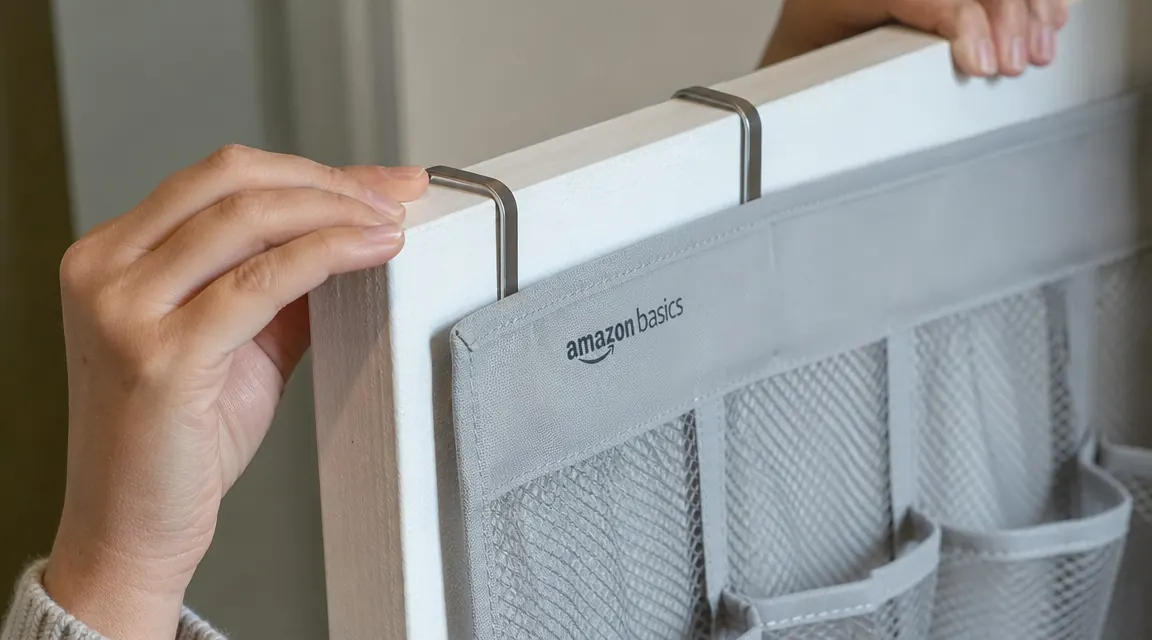
The organizer comes with two metal over-door hooks that slide into grommets sewn into the top edge of the backing. The hooks have a roughly 1.5-inch gap between the J-curve that rests on the door and the back rod that contacts the front face of the door. This measurement is designed for hollow-core interior doors between 1.25 and 1.5 inches thick. Solid-core doors, exterior doors, and some fire-rated doors in newer buildings run 1.75 to 2 inches thick. The hooks will not close around those properly. They will rest on top but the organizer will sit tilted outward and will rock every time the door closes.
If you have a thick door, you have two options. First, move the organizer to a closet door, which is almost always a hollow-core interior door regardless of the building age. Second, purchase replacement hooks with a wider gap, available for about $3 on Amazon, and swap them in. I did the closet-door route in my second apartment and it worked fine. The closet location has a bonus: you put your shoes away the moment you take them off, which is a habit loop that works much better than I expected.
Does It Scratch the Door
After two years across three hollow-core doors, I have no scratches and no paint scuffs on any of them. The hook ends are rounded and smooth, not sharp. The contact point on the back face of the door is a rubber-coated strip on the rear of the hook, which prevents metal-on-paint contact. I have taken the organizer down for both moves and inspected each door before returning the keys. No marks, no issues, nothing that would trigger a landlord dispute.
The one thing I would watch: if you hang it on a door that gets slammed regularly, the hooks can rock and eventually the repeated contact might leave a wear mark on painted trim. My front door in the first apartment closed on a magnetic catch, so it never slammed. My closet door in the second apartment had a soft-close mechanism. Current front door closes gently. So I cannot speak to what a hard-slamming door does over two years. If your door gets slammed by a partner or kids, I would suggest adding a thin strip of foam padding to the hook contact points as a precaution.
What I Liked
- Hangs on any hollow-core interior door with no tools or drilling, zero deposit risk
- Mesh quality held up through 24 months of daily use with no tears or blown seams
- 24 pockets is genuinely enough for a one-to-two-person household of small-to-medium shoes
- Light grey color is neutral enough to work in any apartment color scheme
- Doubles as non-shoe storage for gloves, bags, small accessories, and cleaning supplies
- Folds flat in under 30 seconds for moves, takes 5 minutes to re-hang at the new place
Where It Falls Short
- Pocket depth (4.5 inches) excludes men's shoes over size 10 and most large sneakers
- Hook gap fits doors up to about 1.5 inches thick; solid-core and exterior doors require replacement hooks
- Stuffing two shoes per pocket stretches the mesh and causes drop-outs on anything thicker than a flip-flop
- No reinforced bottom pockets for heavier shoes, so heavy boots will sag over time
- The light grey color shows scuff marks from dark-soled shoes after several months
What I Use It For Beyond Shoes
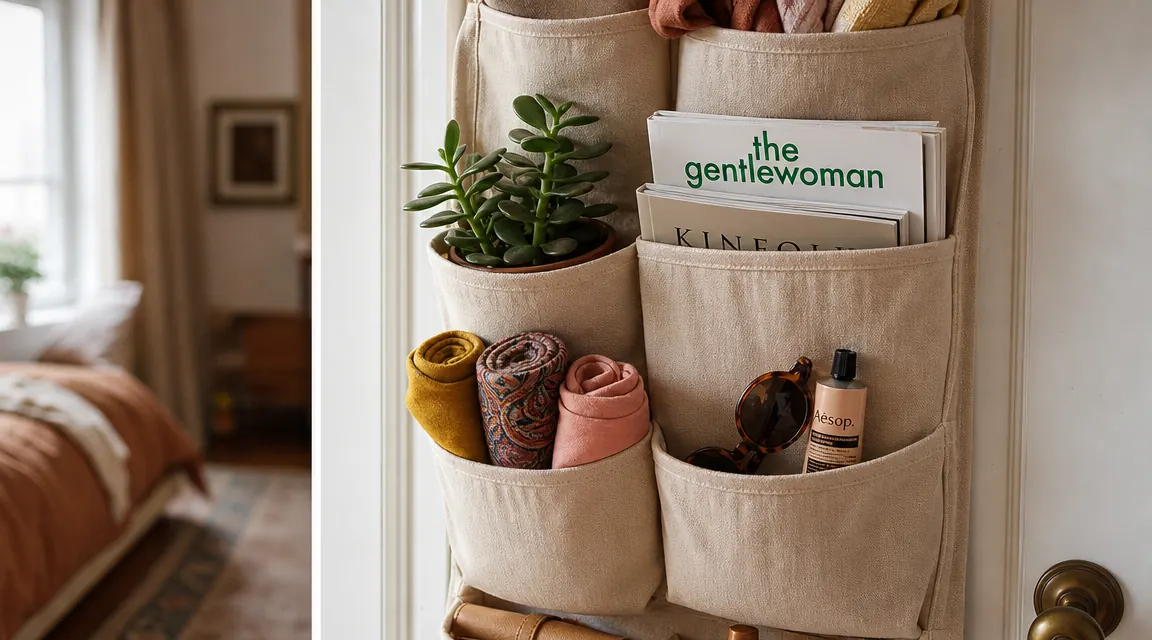
About eight months in I started treating the lower six pockets as general-purpose entryway storage. Currently those pockets hold: one reusable grocery bag folded into a square, one pair of gardening gloves, one small umbrella collapsed into its sleeve, one shoe-cleaning kit in a zippered pouch, and two dog waste bag rolls in a small dispenser. The mesh holds all of these without complaint. The gardening gloves fit especially well because the 6-inch pocket width accommodates a full-size glove laid flat.
I have also seen people use this organizer in bathroom closets for toiletries, in laundry closets for cleaning supplies, and in kids' rooms for small toys and art supplies. The mesh visibility means you can see what is in each pocket without pulling everything out, which is genuinely useful for anything you grab in a hurry. I have not tried those locations but the product mechanics work exactly the same regardless of what you put inside.
Who This Is For
You will get the most out of this organizer if you are a renter with a small-to-medium shoe collection dominated by women's sizes, if your entryway or closet has a standard hollow-core interior door, and if your primary problem is floor clutter rather than volume. This is not a product that dramatically increases your shoe storage capacity. It moves shoes from the floor to the door. The floor space you reclaim is the win. For a 400-square-foot studio or a one-bedroom apartment where the entryway doubles as a hallway, that cleared floor is a meaningful quality-of-life improvement.
Who Should Skip It
If you wear primarily men's shoes in size 11 or larger, this organizer will frustrate you. The pockets are simply too shallow. Look instead at an over-door hanging shelf organizer, which has open shelves rather than mesh pockets and can hold larger shoes lying on their sides. If you have a large household with many pairs of boots and athletic shoes, you will hit capacity quickly and the math on multiple organizers gets awkward. A floor-to-ceiling shoe cabinet or a freestanding shoe bench may be a better investment. And if your only available door is a solid-core exterior door and you do not have a closet door to use as an alternative, skip this and look for a wall-mounted solution instead.
Two years of daily use and I would buy it again at this price without thinking about it.
The Amazon Basics 24-pocket organizer clears your entryway floor in under ten minutes, needs zero tools, and moves with you to every apartment. Check the current price before your next move.
Amazon Check Today's Price on Amazon →